



To ensure healthcare capacity and the preparedness of Urgent Care Centers (UCCs) during the Lunar New Year, President Ching-Te Lai inspected the Xinyi Outpatient Clinic of Taipei City Hospital on February 14. President Lai was accompanied by Minister Chung-Liang Shih of the Ministry of Health and Welfare (MOHW), Director General Lian-Yu Chen of the National Health Insurance Administration (NHIA), as well as Deputy Mayor Yi-Hua Lin of Taipei City, Commissioner Chien-Hua Huang of the Department of Health of Taipei City, and Commissioner Ran-Chou Chen of the Department of Health of New Taipei City. He also greeted patients and expressed appreciation to the healthcare professionals.
The NHIA allocated NT$1.6 billion for the Lunar New Year incentive program, encouraging medical institutions and pharmacies to open. The program focuses on ensuring critical care, preventing emergency room congestion, and providing access to healthcare for minor conditions. Clinic operation rates have significantly increased, with hospital services at 76%, clinics at 45%, and community pharmacies between 30% and 60%.
Minister Shih noted that emergency room visits during the holiday are 1.5 to 1.7 times the usual rate, with most patients having non-critical symptoms. Patients can check clinic information via the “Lunar New Year Healthcare Service Inquiry” section in the NHI App (My Health Bank), and those with respiratory or gastrointestinal symptoms are encouraged to visit hospitals' special clinics for infectious disease or UCCs to reduce waiting times.
Director General Chen also emphasized that, to strengthen healthcare capacity during the Lunar New Year, the NHIA has, for the first time, allocated NT$1.6 billion to the incentive program. For hospitals, a 100% add-on fee will be applied for emergency care, in-patient consultations, nursing, and pharmaceutical service fees throughout the holiday. A 100% add-on fee will be applied from February 16 to February 19; 50% on February 20 and 21, and 30% on February 14, 15, and 22. This aims to ensure patients' needs are met without overwhelming large hospitals.
In addition, during February 2026, the treatment plan cap under the Outpatient Parenteral Antimicrobial Therapy (OPAT) Incentive Program will be extended from 5 days to 7 days. This adjustment is expected to enhance ward utilization efficiency and reduce waiting times for hospital beds. A 100% add-on payment will be applied to all personnel fees related to OPAT services during the holiday. Additionally, 13 UCCs remain operating during the holiday, except for February 16 and February 21. UCCs primarily treat patients with urgent but non-severe conditions. A "green channel" is available for critical or complex cases requiring immediate referral to medical centers.
For the first time, a dedicated "Lunar New Year Healthcare Service Inquiry" section has been added to the NHI App. By selecting the date and time, users can easily check the schedules of medical institutions, pharmacies, and UCCs. The government and healthcare professionals nationwide are working together to ensure the health of the public.
 ▲Fig. 1: On February 14, 2026, President Ching-Te Lai (center) inspected the Xinyi Outpatient Clinic of Taipei City Hospital to review healthcare capacity and UCC during the Lunar New Year, and was accompanied by MOHW Minister Chung-Liang Shih (fifth from the right), NHIA Director General Lian-Yu Chen (fourth from the right).
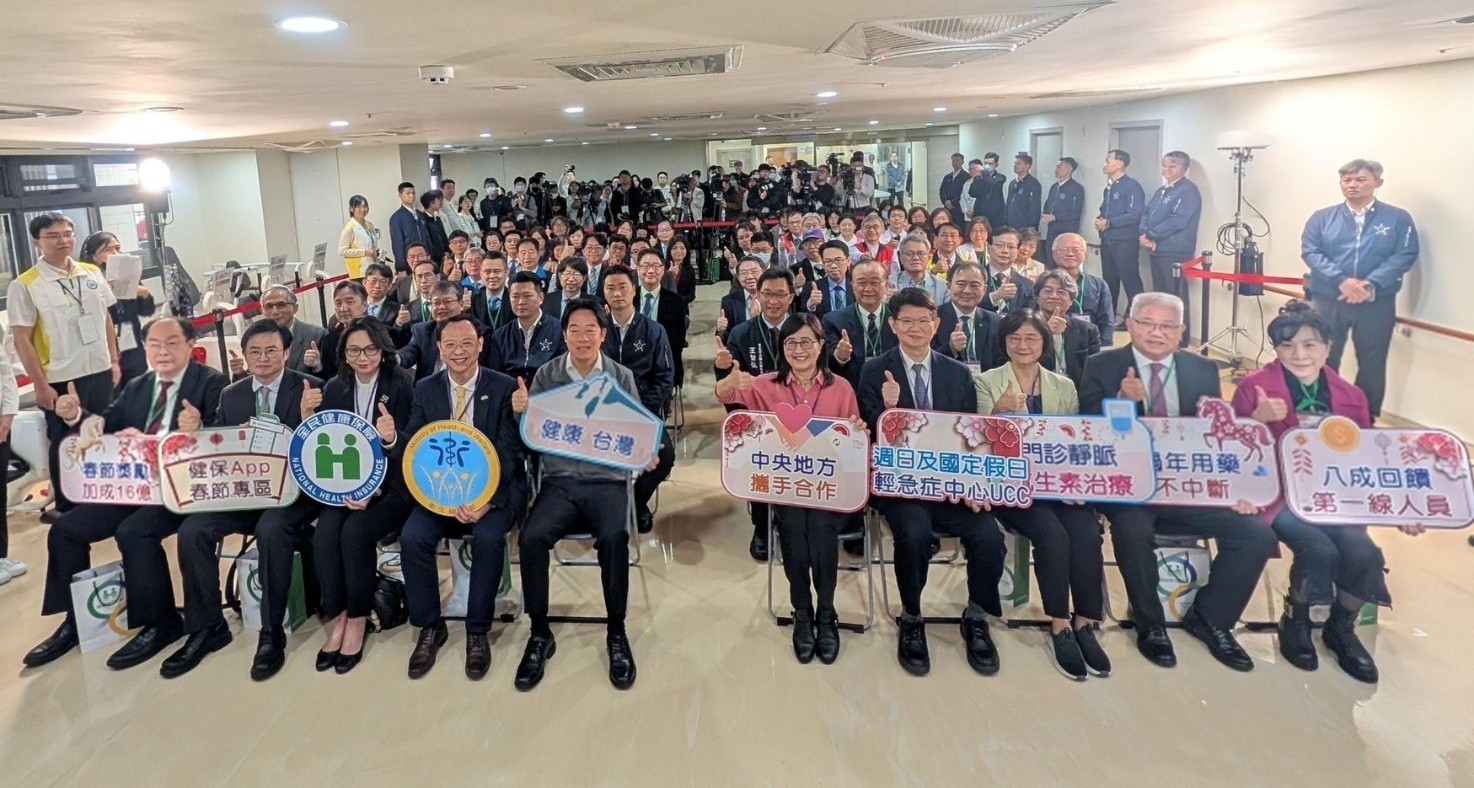 ▲Fig. 2: A group photo of all distinguished guests in attendance of President Ching-Te Lai’s on-site inspection at the Xinyi Outpatient Department of Taipei City Hospital and the UCC on February 14, 2026.