


To improve healthcare quality in rural and remote areas, the National Health Insurance Administration (NHIA) launched the Integrated Delivery System (IDS) Program in 1999, encouraging medical centers and regional hospitals to extend healthcare services to mountainous areas and offshore islands. In 2026, the NHIA has allocated up to NT$1.6 billion in funding to the program, 2.8 times the level in 2023. The IDS program serves around 600,000 patient visits annually.
In addition, the NHIA has implemented the Telemedicine Payment Program to expand digital healthcare services since 2020. With teleconsultation systems, patients in remote healthcare facilities can connect in real time with specialists at partner hospitals in urban areas, receiving specialist care comparable to that provided by major urban hospitals. To date, this program has served more than 50,000 patient visits. Furthermore, the NHIA lifted specialty restrictions on teleconsultations in August 2025 and expanded its coverage, significantly improving access to healthcare in remote areas.
Moreover, the NHIA also works with private charitable organizations to strengthen telemedicine services in underserved areas. The NHIA and Rotary International District 3481 held a donation ceremony, with Rotary Clubs donating eight types of medical devices and equipment valued at up to NT$5 million to five medical institutions in Hsinchu County, Tainan City, and Taitung County. The donation included medical AR smart glasses, telemedicine platforms, portable and handheld ultrasound devices, digital otoscopes, digital oral inspection scopes, and flexible video nasopharyngoscopes.
Minister Chung-Liang Shih of the Ministry of Health and Welfare (MOHW) noted that the government has been promoting telemedicine in recent years. Since the promulgation of relevant telemedicine regulations in 2018, the MOHW has provided subsidies to public health centers and mobile healthcare locations to upgrade broadband internet and medical IT equipment. Additionally, teleconsultations have been incorporated into the NHI reimbursement scheme. Residents in remote areas no longer need to travel long distances to access specialist care. Strengthened public-private collaboration can further expand healthcare services and build a more comprehensive healthcare network for local communities.
Director General Lian-Yu Chen of the NHIA stated that initiatives such as the IDS program and the Holistic Integrated Care program demonstrate the government's commitment to rural healthcare. Continuous progress in underserved areas requires the joint efforts of the government, medical institutions, and private organizations such as Rotary Clubs, which have long supported healthcare development in collaboration with the NHIA. The donation of medical devices and equipment helps build up local healthcare capacity and improves the timeliness and quality of care for local residents in these areas.
The NHIA will continue to strengthen telemedicine networks, enhance specialist support, and upgrade medical infrastructure to meet the medical needs of rural healthcare, supporting the vision of a Healthy Taiwan.
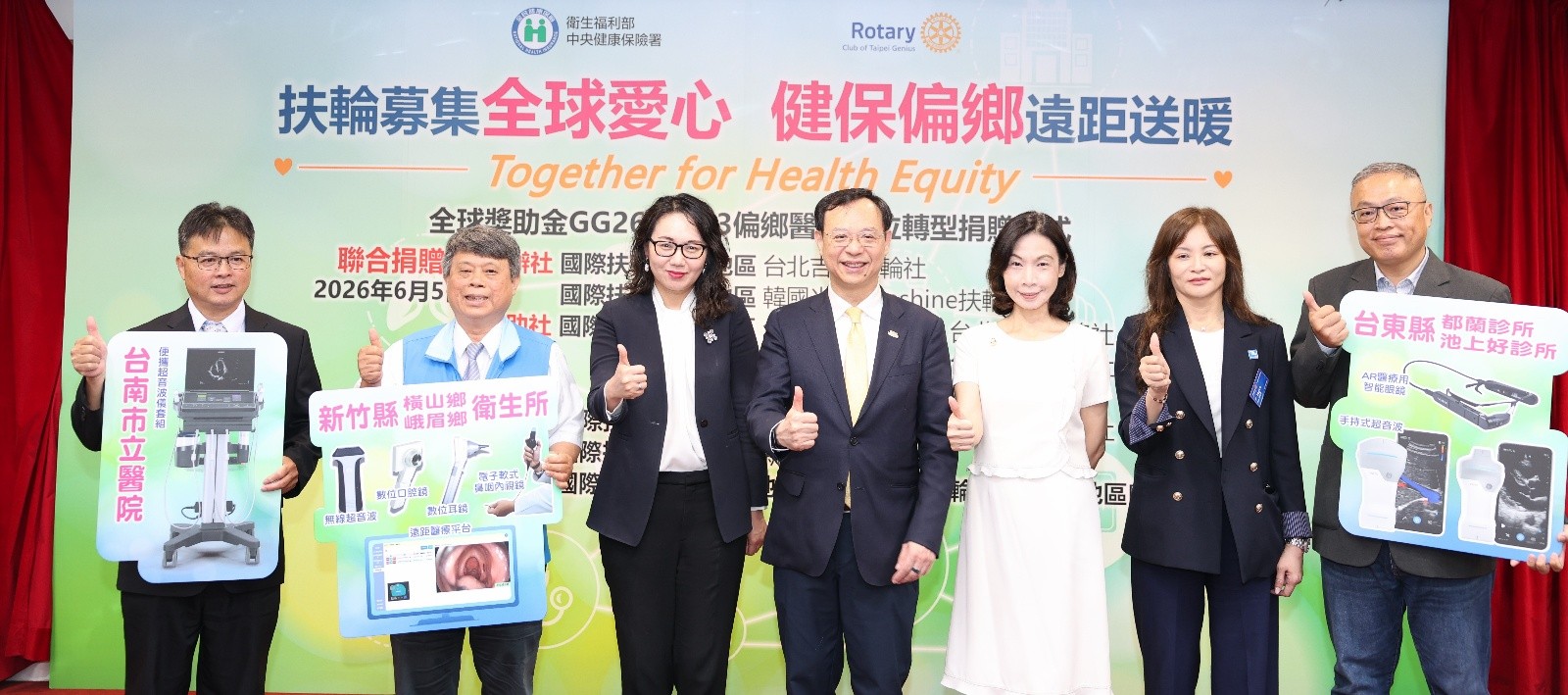
▲Fig. 1: The NHIA and Rotary Club held a donation ceremony, witnessed by Minister Chung-Liang Shih (center) and Director General Lian-Yu Chen (left of center). Rotary representatives donated medical device and equipment to healthcare institutions.