



In response to a rapidly aging society and the growing demand for chronic disease care, President Ching-Te Lai has advanced the "Healthy Taiwan" initiatives, including the 888 Program for Chronic Disease Management, home-based healthcare, and smart healthcare. President Lai and Professor Jyh-Hong Chen, Deputy Convener of the Healthy Taiwan Promotion Committee, have encouraged the evaluation of healthcare policy outcomes through scientific research, thereby improving population health through evidence-based governance and sharing Taiwan's healthcare experiences with the international community.
Minister Chung-Liang Shih of the Ministry of Health and Welfare (MOHW), together with nine major medical associations, including the Taiwan Society of Lipids and Atherosclerosis, jointly published the "2025 Consensus on the Clinical Pathway of Blood Cholesterol Management in Taiwan" in the Journal of Internal Medicine of Taiwan. The paper established a standardized care model tailored to Taiwan's clinical needs. In line with the emphasis on evidence-based healthcare, the National Health Insurance Administration (NHIA) launched the Acute Care at Home Pilot Program in July 2024. NHIA Director General Lian-Yu Chen, Professor Ching-Ching Lin of National Taiwan University, and a research team led by Dr. Ping-Jen Chen of the Taiwan Society of Home Health Care subsequently published the program's outcomes in the Journal of the Formosan Medical Association, under the title "Taiwan's Acute Care at Home Program: Early National Experience and Evaluation Using a Logic Model". The publication highlights Taiwan's innovative approach to addressing the challenges of an aging population and healthcare transformation.
Director General Chen stated that the Acute Care at Home Program provides home-based treatment for patients with pneumonia, urinary tract infections, and soft tissue infections, offering an alternative to hospitalization. Through remote monitoring technologies and multidisciplinary team-based care, patients can receive comprehensive treatment in a familiar environment. This program is one of the few large-scale, government-supported acute care at home models in Asia. The research showed that, as of the end of March 2025, the program had benefited a total of 2,158 patients, including 679 receiving care at home, 652 receiving care in residential long-term care institutions, and 827 returning home after emergency department visits. The program has demonstrated strong outcomes, with 89.9% of patients successfully completing treatment. Within 14 days after completing care, the emergency department visit rate was only 2.9%, and the unplanned readmission rate was 3.7%, demonstrating the safety and feasibility of acute care delivered at home. To further expand the program's benefits, the NHIA introduced the Early Discharge Model on May 1, 2026, allowing clinically stable patients who meet specific criteria to be discharged early and receive home care. The model has also been expanded to cover all infectious diseases, better meeting patient needs while promoting more efficient use of healthcare resources.
The Acute Care at Home Program integrates the NHI system, community healthcare, hospital resources, and smart technologies. Through multidisciplinary collaboration, technological innovation, and the transformation of care delivery models, the program improves health outcomes and the quality of healthcare services while enabling patients to receive appropriate care at home. This approach not only addresses the growing healthcare needs of an aging society but also demonstrates the resilience of Taiwan's healthcare system.
Appendix: Link to the published article (https://www.sciencedirect.com/science/article/pii/S0929664626003323)
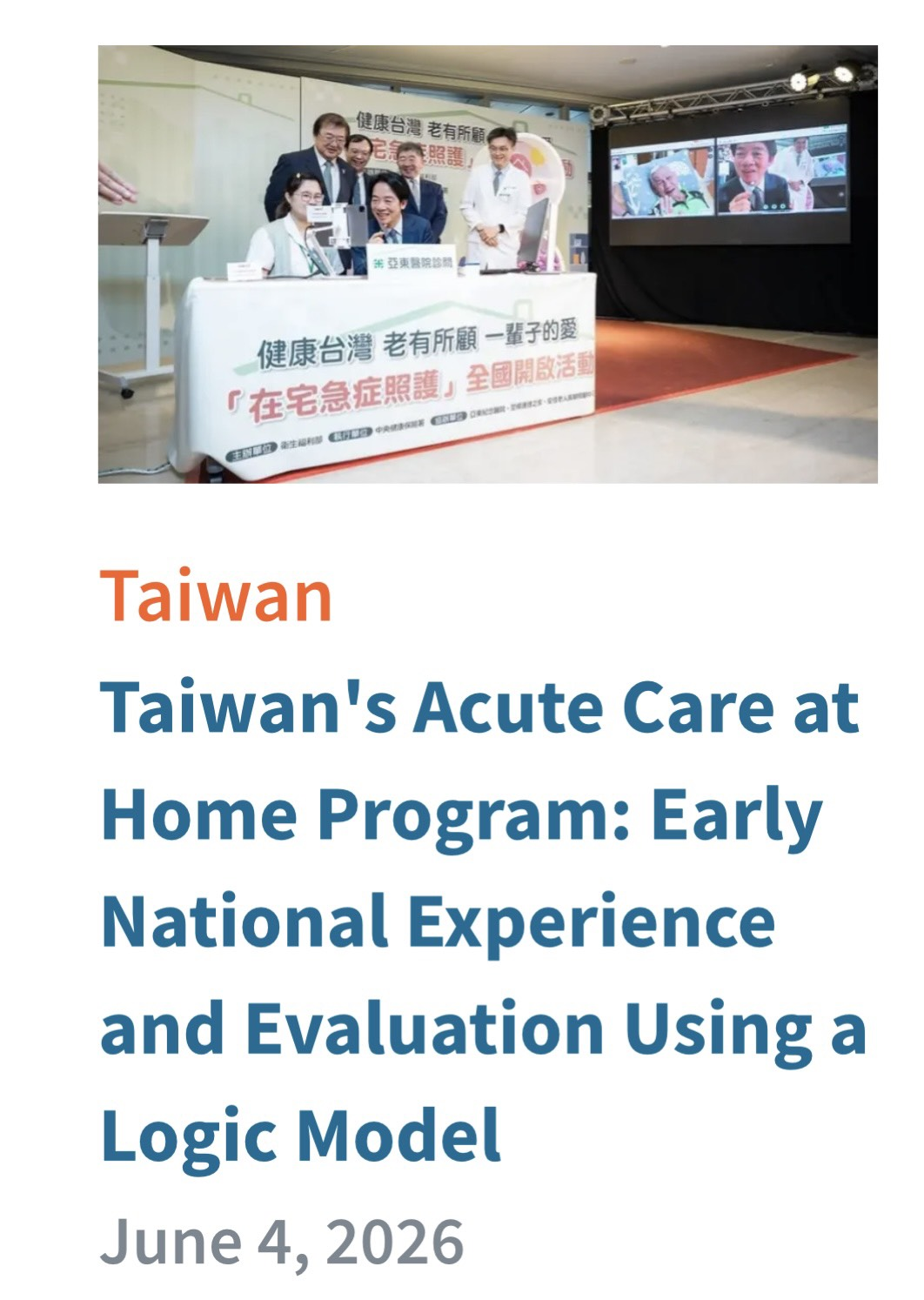 ▲Fig.: The article was published on the official website of the Association of Schools and Programs of Public Health (ASPPH).