



In response to the healthcare needs of a super-aged society and to strengthen the post-acute rehabilitation care system, the National Health Insurance Administration (NHIA) has launched the NHI Rehabilitation Ward Pilot Program. For the first time, home environment simulation has been incorporated into inpatient rehabilitation under the NHI, helping stroke patients transition back home and resume daily life.
On August 14, President Ching-Te Lai, accompanied by Deputy Minister Ching-Yi Lin of the Ministry of Health and Welfare (MOHW), NHIA Director General Lian-Yu Chen, Changhua County Magistrate Hui-Mei Wang, and Director Yen-Po Yeh of the Changhua County Public Health Bureau, attended the program's launch press conference at Yuankuo Hospital in Changhua County. The establishment of rehabilitation wards marks a major step forward for Long-Term Care 3.0 and a new milestone for rehabilitation medicine in Taiwan.
From Caring for Disability to Reducing Disability
Taiwan has an average life expectancy of 80 years, with approximately 8 years spent in poor health, accounting for one-tenth of a person's lifetime. President Lai stated that, to realize the Healthy Taiwan vision, national resources should focus not only on caring for people with disabilities but also on reducing disability. Rehabilitation wards extend the continuum of care to functional recovery and independent living.
Deputy Minister Lin noted that the program will connect acute treatment, functional recovery, and re-engagement with daily life. The pilot program will address a critical gap in rehabilitation care following acute treatment through establishing multidisciplinary care, quality management, and value-based payment for care teams.
Multidisciplinary Teams to Achieve Functional Recovery and Support Independent Living
Director General Chen noted that Taiwan records approximately 30,000 to 50,000 new stroke patients each year. With advances in neurology, the critical window for rehabilitation has extended from three months to six months. Medical evidence shows that intensive rehabilitation plays a critical role in reducing long-term disability.
The patient-centered pilot program draws on the model of Japan's Kokura Hospital while leveraging existing resources within Taiwan's healthcare system. It focuses on rehabilitation care for functional recovery and independent living. Multidisciplinary teams comprising rehabilitation physicians, nurses, physical therapists, occupational therapists, speech therapists, and dietitians work together to develop individualized treatment plans for each patient, supported by intensive rehabilitation, home environment simulation, and comprehensive discharge preparation.
NT$300 Million Investment in Rehabilitation Wards to Help Patients Return to Daily Life
The NHIA has allocated NT$300 million this year to the pilot program. With 10 hospitals participating in the initial phase, the program is expected to provide intensive inpatient rehabilitation care to approximately 1,600 patients with rehabilitation potential each year.
Director General Chen emphasized that rehabilitation wards are designed to help patients rebuild the skills needed to live independently. She likened them to "rehabilitation schools," where multidisciplinary teams provide intensive, structured training alongside home environment simulation. Through this approach, patients relearn essential activities of daily living (ADL), such as standing, walking, dressing, and eating, to prepare for their return home. The intensive rehabilitation approach is expected to improve patients' self-care abilities and enhance the quality of life of patients and their families.
A Physician's Firsthand Experience: Returning to Work Through Integrated Rehabilitation
Dr. Bi-Fang Cheng, an emergency physician at MacKay Memorial Hospital, shared his rehabilitation experience following a stroke. Having gone from a physician caring for patients to a patient undergoing rehabilitation himself, Dr. Cheng underwent an extended period of inpatient rehabilitation and home environment simulation. He eventually regained his independence and returned to work in the emergency department.
Dr. Cheng noted that home environment simulation gives patients an opportunity to practice real-life activities before discharge. He added that the simulation helps the healthcare team tailor rehabilitation plans to patients' needs, underscoring the value of rehabilitation wards in helping patients return to their families, workplaces, and communities.
Strengthening Inpatient Rehabilitation Care to Extend Healthy Life Expectancy
In the future, the NHIA will continue to refine the program based on the results of the pilot and gradually expand inpatient rehabilitation capacity. Working with healthcare institutions, the NHIA will develop a patient-centered inpatient rehabilitation care system, providing patients with more comprehensive and continuous care. These efforts will advance the Healthy Taiwan vision of helping people live not just longer, but healthier lives.

▲Fig. 1: The NHI Rehabilitation Ward Launch Press Conference was held at Yuankuo Hospital on August 14, 2026. President Ching-Te Lai (center), MOHW Deputy Minister Ching-Yi Lin (4th from right), NHIA Director General Lian-Yu Chen (3rd from right), Changhua County Magistrate Hui-Mei Wang (4th from left), Director Yen-Po Yeh of the Changhua County Public Health Bureau (3rd from left), Superintendent Chung-Tien Kuo of Yuankuo Hospital (2nd from left), Dr. Bi-Fang Cheng of MacKay Memorial Hospital (1st from left), President Lung Chan of the Taiwan Stroke Society (2nd from right), and Professor Yu-Cheng Pei of Linkou Chang Gung Memorial Hospital (1st from right) joined the event and shared their vision.

▲Fig. 2: Group photo of President Ching-Te Lai (front center), MOHW Deputy Minister Ching-Yi Lin (front row, 4th from right), NHIA Director General Lian-Yu Chen (front row, 3rd from right), healthcare and long-term care experts, and representatives of healthcare professional organizations.

▲Fig. 3: Group photo of all participants at the NHI Rehabilitation Ward Launch Press Conference.
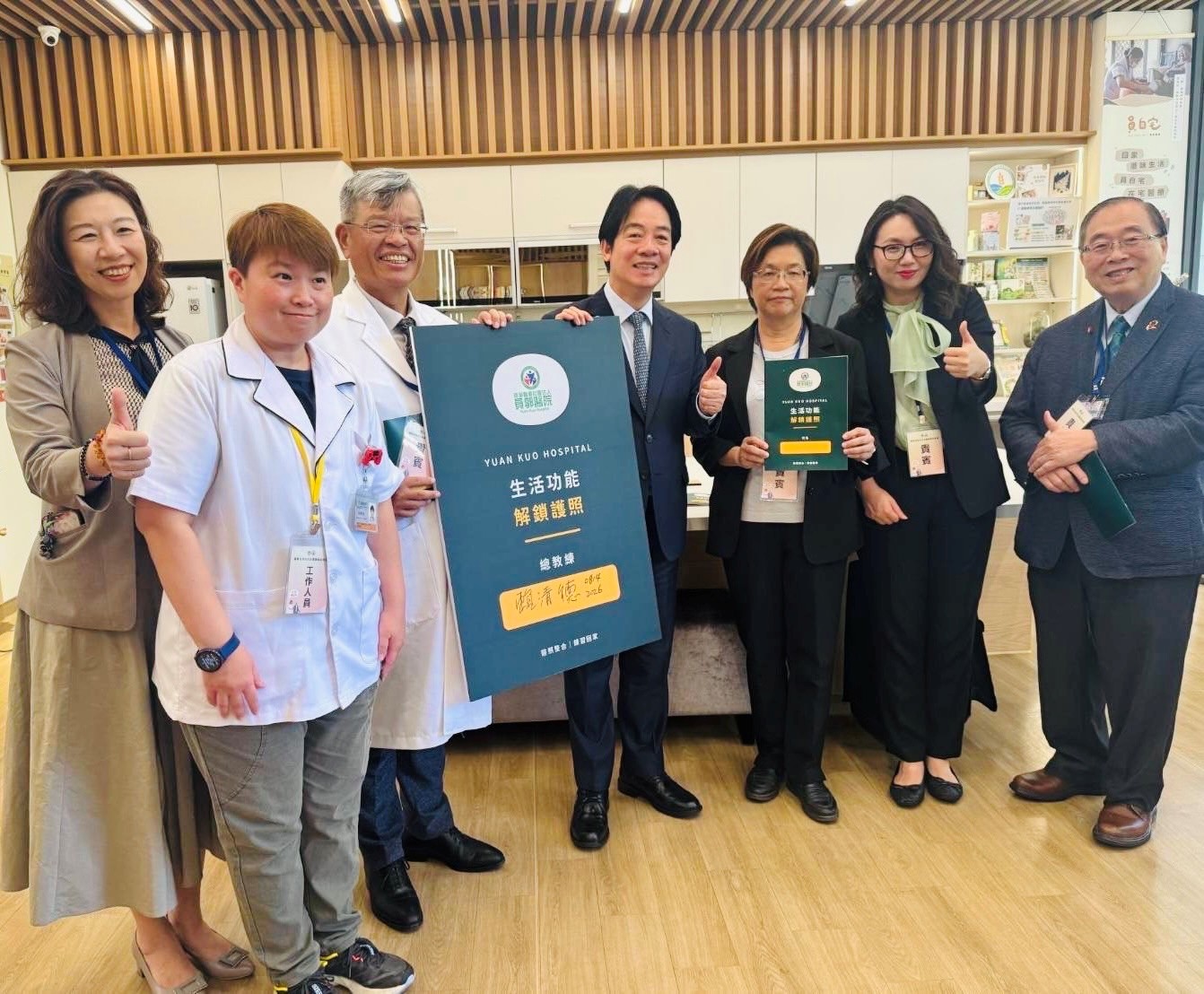
▲Fig. 4: President Ching-Te Lai (center) visits the Y.K. Future Room in Yuankuo Hospital's rehabilitation ward. Staff introduce the "Activities of Daily Living Ability Progress Passport," and President Lai signs the passport as the "head coach."